
BEEPGA stands for Body and Earth: Ecosomatic Practices for Green Ageing. It’s an Erasmus+ KA210 project in adult education, co-funded by the European Union. KA210 is the Erasmus+ funding line for small-scale partnerships: projects designed to be accessible to grassroots and community organisations, not large institutions, which is reflected directly in BEEPGA’s partner line-up.
The project brings together three partners: VulcanicaMente APS in Lecce, Italy; EPIONE in Lithuania; and 4C (Cooperate Communicate Create Change) in Greece. Together they’re building practical learning resources for older adults, educators, and social workers who want to reconnect with the body, nature, and community.
Why the project exists
BEEPGA responds to three challenges converging across Europe at once. The continent’s population is ageing quickly. The number of people aged 55 or older is projected to rise to 129.8 million by 2050, and a 2022 European Environment Agency report has already warned about the health risks this creates when combined with climate change, particularly heatwaves and heat-related illness. At the same time, public appetite for climate action is high: a 2023 Eurobarometer survey found that 88% of EU citizens support a greener future. But many older adults are effectively locked out of that transition, because they lack the digital skills needed to access the information, services, and community resources that a greener, more connected daily life increasingly depends on.
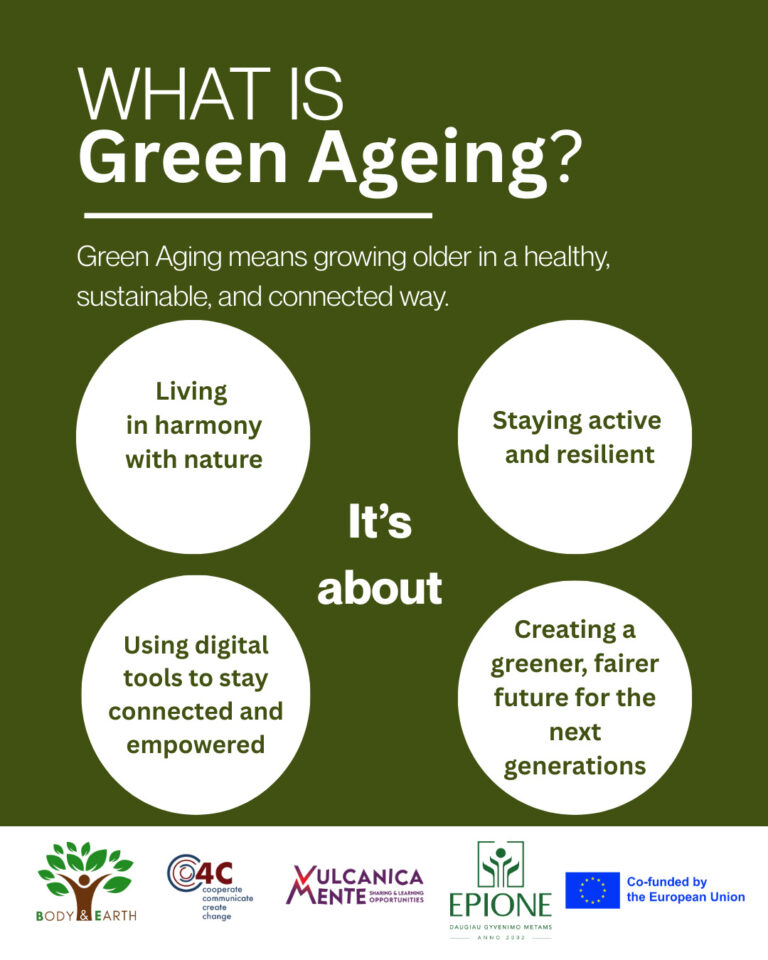
BEEPGA treats these three problems as connected, not separate: ageing, climate change, and digital exclusion. Its response is to combine ecosomatic practices, which link body awareness to ecological principles, with digital literacy training aimed especially at seniors and people with fewer opportunities.
Four objectives, one framework
The project organises its work around four objectives. First, creating opportunities for newcomers: empowering grassroots organisations like VulcanicaMente, EPIONE, and 4C to offer learning that specifically supports vulnerable groups, particularly seniors, in lifelong education. Second, raising climate crisis awareness, using ecosomatic practices to help participants build green wellbeing and ageing strategies grounded in how climate change actually affects their bodies and daily lives. Third, building international collaboration and capacity, so grassroots organisations across the three partner countries can design practices suited to their own communities and sustain them once the project ends. And fourth, growing digital capacity: helping older adults access online resources, follow climate information, and stay connected to their communities.
These four objectives deliberately echo Erasmus+’s own priorities in adult education: fighting environmental degradation, building digital readiness and resilience, and creating inclusive learning opportunities across generations.
Working across three countries
BEEPGA is transnational by design, not by convenience. Working across Italy, Lithuania, and Greece gives the partners access to different cultural and environmental contexts. That matters directly for a project trying to develop ecosomatic practices: approaches that, almost by definition, need to be tested against real differences in climate, geography, and daily life, not designed for one setting and exported elsewhere.
That collaboration is also what makes the project’s main tools possible: the partners are jointly developing an ecosomatic toolkit and a digital literacy framework for seniors, designed from the start to be shared and adapted across all three countries, not built for just one. The logic is straightforward. Addressing green ageing and digital exclusion at a European scale requires cross-border solutions, and lessons learned in one partner country can be transferred and scaled into the others once the project’s formal activities end.
What the project is building
BEEPGA’s research and training activities feed into four practical resources: a Guidebook introducing the project’s approach to green ageing, ecosomatic practices, and inclusive adult learning; a Training Guide for educators and facilitators designing their own body-awareness and wellbeing activities; a set of Ecosomatic Cards supporting reflection, movement, sensory awareness, and group learning; and a Learning Journal for participants and facilitators to document their own experience of the project. Together, they’re meant to outlast the funding period. Grassroots organisations can keep using them with their own communities long after BEEPGA’s formal activities have concluded.
Updates on the project, including its four outputs as they’re published, are available on the Outputs page of this site.
The project Body & Earth is Co-funded by EU.